
Ahead of President Vladimir Putin's visit to India for the BRICS summit, Russia has expressed support for New Delhi's peace initiatives to resolve the Ukraine conflict. Discussions between Putin and PM Modi will cover defence, energy, technology, and the repatriation of Indian nationals from the Russian military, alongside addressing trade and investment ties.

US Secretary of State Marco Rubio's visit to India this week underscores the complex dynamics of global energy policy, as Washington re-evaluates sanctions on Russian oil buyers amidst India's continued reliance on Russian crude.

Prime Minister Narendra Modi met Iranian President Masoud Pezeshkian at the SCO summit, advocating for dialogue and diplomacy to resolve the West Asia conflict and expressing India's desire to expand and diversify trade with Iran. Pezeshkian, in turn, urged India to leverage its contacts to promote peace.

External Affairs Minister S Jaishankar has publicly acknowledged India's intensified diplomatic efforts to resolve the Ukraine conflict, engaging directly with both Kyiv and Moscow. India is focusing on critical issues like Black Sea shipping safety, grain exports, and energy supplies, moving beyond its previous advocacy role. Jaishankar also highlighted India's historical ties with Russia and discussed the evolving global geopolitical landscape, including the repositioning of the US and the rise of China.

Chinese President Xi Jinping addressed the BRICS summit, urging the bloc to play a significant role in achieving peace and tranquillity in West Asia and the Gulf region. He highlighted BRICS' growth over two decades, its efforts in tackling global challenges, and its steadfastness in safeguarding the interests of the Global South. Xi called for opposing the Cold War mentality, strengthening multilateralism, and promoting cooperation in emerging domains like AI, as China prepares to chair the next summit.

'We have a very demanding electorate which expects us to do something. So we will have to do something which is a bit out of the ordinary while at the same time keeping in mind the risk factors.'

In recent years, China and Russia have pushed for de-dollarisation within BRICS, which India has resisted. One reason is that India does not want to hurt its relationship with the United States, and another is the fear of China controlling trade because the renminbi is considered the strongest currency in the bloc today.

Prime Minister Narendra Modi arrived in Sweden to hold talks on trade, technology, defence and other key sectors with his Swedish counterpart Ulf Kristersson.
Commerce and Industry Minister Piyush Goyal announced that a US team is expected to visit India next month for trade talks, following an earlier Indian delegation's visit to Washington, DC, in April to finalise an interim pact and advance negotiations for a broader bilateral trade agreement.

Poland's Secretary of State, Wladyslaw T Bartoszewski, has credited Prime Minister Narendra Modi with preventing Russian President Vladimir Putin from using tactical nuclear weapons in Ukraine in late 2022, highlighting Modi's significant influence on the Russian leader.

Prime Minister Narendra Modi met his Italian counterpart Giorgia Meloni in Rome to discuss ways to strengthen the India-Italy friendship, marking the final leg of his five-nation tour.

Xi brought in asymmetrical power play by stating that India should have 'strategic cognition' and 'strategic judgement made on the basis of the stage of development the two countries are at'. This is a very nuanced way of asserting China's coercive diplomatic posture and reflects Beijing's penchant to unleash border instability at will, restrict rare earth metal exports, exert pressure on India at global and regional orders, asserts China expert Srikanth Kondapalli.

Notwithstanding the economic complementarities and the host of agreements for deepening economic relation on a host of areas, both sides share common viewpoints on the foreign policy domain and seek common grounds to serve as a counterweight to China, notes Dr Rajaram Panda.

US Ambassador to India Sergio Gor revealed that President Donald Trump views Prime Minister Narendra Modi as 'a friend' and is deeply committed to enhancing cooperation with New Delhi, highlighting their personal equation as a crucial factor in advancing bilateral ties.

'Every period of excessive optimism eventually gives way to a correction, while periods of extreme pessimism often create the best investment opportunities.'

US Ambassador to India, Sergio Gor, highlighted the evolving US-India space partnership, moving from cooperation to "co-creation" at the Bengaluru Space Expo. He emphasised joint design, funding, and co-authoring the future of human discovery, citing the NISAR satellite and India's participation in the Artemis Accords as key examples of this growing synergy.

Over the years, India-EU ties have grown, and covered trade, investment, climate change, science and technology, space, digital, mobility, and connectivity.

This article details the quarter-century journey of BRICS, from its inception as an economic acronym by a Goldman Sachs economist to its current status as an expanded eleven-member international bloc. It highlights its growth, key historical moments, and the significance of its upcoming summit, particularly with Iran's renewed importance in discussions.

Prime Minister Narendra Modi has called for a swift end to the conflicts in West Asia and Ukraine, emphasising the importance of dialogue and diplomacy. He made the remarks after talks with Finnish President Alexander Stubb, where they also agreed to a strategic partnership in digitalisation and sustainability.

Amidst global energy market volatility driven by the West Asia crisis, Russia has proposed increasing its crude oil and natural gas supplies to India, strengthening bilateral energy ties and aiming for USD 100 billion in annual trade by 2030.

Japan is deepening its defence relationship with India while simultaneously expanding its economic, infrastructure and security engagement with countries around India -- particularly Bangladesh. The result is an emerging Japanese conception of South Asia in which India remains the strategic anchor, but the geography surrounding India is becoming increasingly important, points out Varun Arya.

India and Australia have signed significant agreements covering civil nuclear energy, maritime security, and critical minerals, reinforcing their partnership's role in ensuring a peaceful Indo-Pacific. The pacts facilitate uranium supply from Australia to India and enhance cooperation in defence, cyber, and critical technologies.

'Improved law and order and transparent governance have helped change UP's investment image.'

Pakistan Prime Minister Shehbaz Sharif expressed 'forever grateful' to US President Donald Trump for his 'timely' intervention in securing a ceasefire with India following a military conflict last year, a claim India has consistently rejected.

The Reserve Bank of India (RBI) has maintained its benchmark policy rate at 5.25 per cent for the fourth consecutive meeting, prioritising clarity on inflation trends, particularly concerning energy costs and geopolitical developments.

Prime Minister Narendra Modi's visit to Italy concluded with the elevation of India-Italy relations to a Special Strategic Partnership, focusing on enhanced cooperation across various sectors.

Prime Minister Narendra Modi was accorded a grand welcome on his arrival in Jakarta on Monday, with Indonesian Air Force fighter jets escorting the PM's aircraft upon entering Indonesian airspace, marking a ceremonial welcome.

Prime Minister Narendra Modi and Indonesian President Prabowo Subianto have significantly advanced the India-Indonesia Comprehensive Strategic Partnership, securing crucial agreements on defence, critical minerals, and maritime security, including BrahMos missile supply and Sabang port development.

Russia's First Deputy Prime Minister Denis Manturov met with Indian leaders to discuss strengthening bilateral ties in key sectors amidst the escalating conflict in West Asia.

An innovation roadmap, a mechanism to double annual bilateral trade within next five years, and a joint artificial intelligence framework were among 13 outcomes to emerge from wide-ranging talks between Prime Minister Narendra Modi and President Emmanuel Macron on Sunday.

Over Rs 180 crore was incurred on Prime Minister Narendra Modi's visit to 23 countries including the US, the UK, France, China and Japan in 2025, according to data shared by the government.
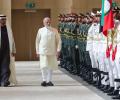
Prime Minister Narendra Modi has offered India's support to bring peace to West Asia during talks with UAE President Sheikh Mohamed bin Zayed Al Nahyan. Both countries signed agreements to strengthen strategic collaborations in energy and defence.

Prime Minister Narendra Modi will visit the UAE, the Netherlands, Sweden, Norway and Italy to deepen India's bilateral ties amid geopolitical changes.

Prime Minister Narendra Modi visited the Melbourne Cricket Ground, announcing India's aspiration to host the 2036 Olympics and welcoming Chennai's role in the Big Bash League. He emphasised cricket as a strong bond between India and Australia, and both PMs unveiled a Roadmap on Sport Cooperation to deepen bilateral ties beyond cricket.

Indian companies' overseas expansion plans are holding strong despite geopolitical tensions in West Asia, driven by structural factors like supply-chain diversification, free trade agreements, and market expansion, according to Ajay Sharma, managing director and head of banking at HSBC India.

Prime Minister Narendra Modi will visit Israel to enhance defence and trade cooperation amid Middle East tensions. Discussions will include defence, security, and the situation in Gaza.

US Secretary of State Marco Rubio will visit India for four days to strengthen bilateral relations, holding talks with Indian leaders and attending the Quad foreign ministers' meeting.

Myanmar President U Min Aung Hlaing assured Prime Minister Narendra Modi that Myanmarese territory would not be allowed to be used against India's security interests, as the two leaders held wide-ranging talks to boost bilateral ties in trade, defence, and energy.

India's procurement of Venezuelan crude oil has picked up momentum since April and the South American nation has already emerged as the third largest oil supplier to the country.
History may remember Takaichi Sanae not as the leader who simply accelerated Japanese rearmament, but as one who governed during Japan's transition from an industrial-age security model to a post-industrial strategic member of the global order, points out Varun Arya.
